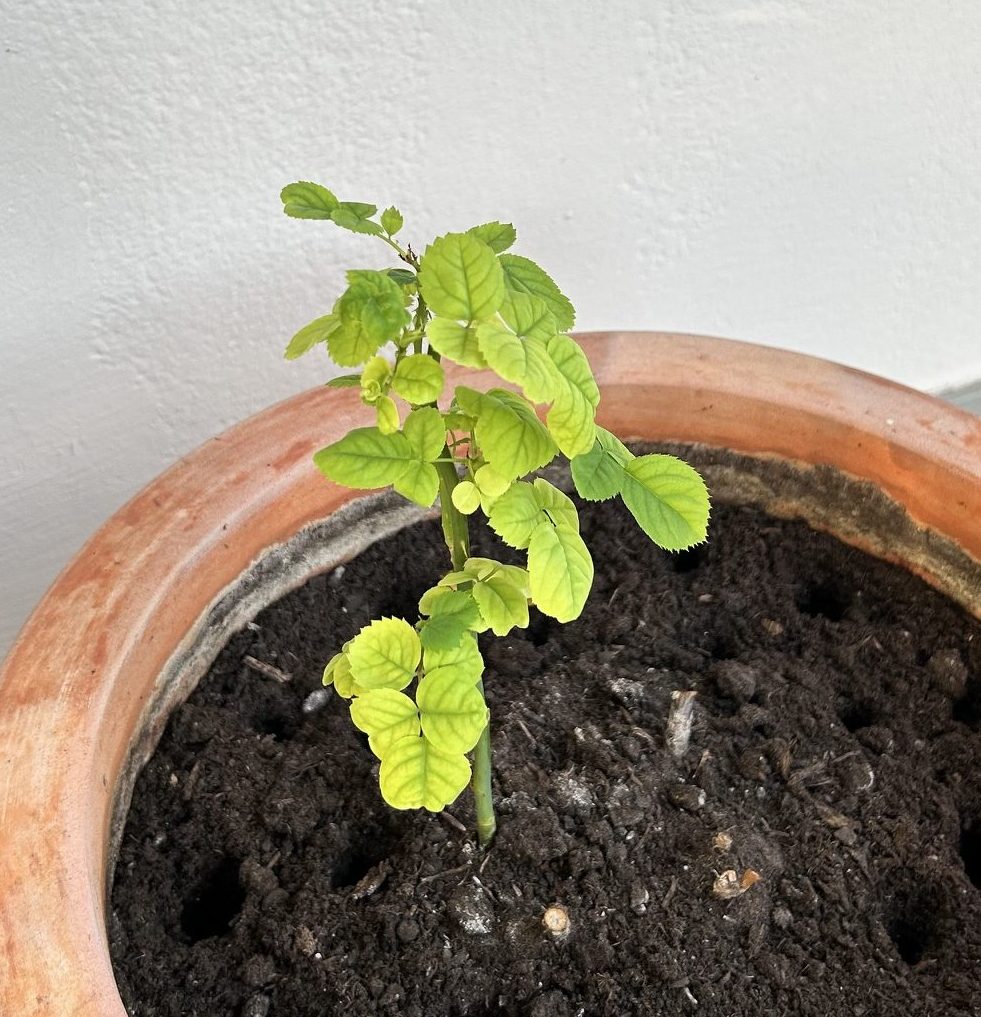
This small plant is my oldest rose. I have had it for more than 20 years. Usually, it is much bigger and carries very delicate, beautiful ivory-coloured flowers. At the moment it looks very small and a bit pitiful. I have given it too much water after replanting it into new soil. We had very hot weeks this summer, and I worried this poor plant would need more water. However, roses need only modest to medium humidity. Even though I knew that, and even though I had started measuring humidity with a humidity meter, I couldn’t resist watering it again after a couple of hot days.
I just could not resist that worry and temptation. The result: Drying leaves, while the soil was watered and humid, because the roots don’t like it and start to rot. Now I read more about what to do: You drill holes into the soil to allow it to dry faster. And above all: You consequently stop watering the plant! As long as it needs to let the soil dry. Only when you see the plant pushing new leaves and when the soil measurement shows dry soil, you start to water again. What did I do: I left it for a week; some growth was visible. I measured medium humidity – and went there and watered it again. I could not resist. Now we are back with high (too high) humidity and nearly no growth. The plant survives, but it is not doing well. I am not a bad gardener – all the other years it worked, and other roses flourish very well this year.
Now I am standing in front of that little plant, watching it every day in the morning, and I feel like: I would love to pull you up and make you grow! But we know that won’t work at all. So I stand there; I know I must not do it, but I feel that strong temptation to at least give it some water!
With people and how they grow and how they produce new innovative results together, it is the same: Some leadership and support is good, too much steering is bad. It makes them passive, and it kills a spirit of taking risks, taking responsibility and going into leadership. Instead, we have to look at the conditions that may hinder or allow certain behaviours. Like with my rose: Pulling won’t work. Giving the right degree of humidity, that works.
Thus, let me ask you: Have you felt that temptation to go and steer your team, because the results were not coming as fast as wished?
Haven’t you had that situation where you thought, “These people need a bit more steering now and you gave them steering, and it got worse: Less responsibility, fewer ideas, less creativity – and still not really good results. And then you thought: Ok, I’ll leave it; they must find their way. And then, too soon, you fell back into: Ok, let’s give it some more guidance and let me show them how they can do it?
Or maybe you are at the point where I was 5 weeks back: I was not even aware that I was watering the plant too much. Have you asked yourself: Might the steering, guiding, and telling them how it works be the real reason why I don’t see more coming from them?
How much steering is good and why? When does leadership turn into steering? Are you looking at ‚what they should do‘ – or are you designing good conditions around them, including removing bad conditions, such as too much steering?

