
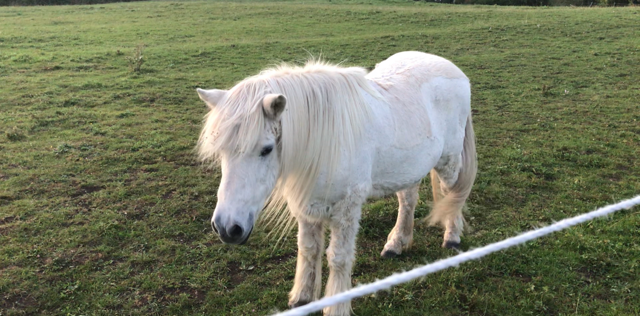
A short chat message exchange with an acquaintance leads me to the conclusion: The old pony is always right.
We had briefly talked about a work appointment that had to be postponed due to illness, and somehow ended up discussing where on earth one is supposed to find the time for all the things we have to fit in — or want to fit in — at work and in our private lives. We quickly agreed that time with the pony, already 31 years old, should definitely take priority (in human years, that’s about 95!). And we agreed that overtime at work (or simply “working more”) is usually not the solution to problems at work.
I thought: the pony is already old — who knows when it will die — so you’d better spend time with it while you still can.
But I also thought — and I told her this — the pony is a “giver of good time.” And that is precisely why the pony deserves priority even more. I would even claim: The pony makes us happy in our free time, but also more productive at work. Because only brains and people and souls that are truly relaxed for once, that can breathe deeply and let everything go, can see the forest behind all the trees again and approach things with a clear view, free thoughts, good faith and good patience.
A few weeks earlier, my acquaintance had told me that thanks to a few sick days at home, she had gained a clearer view of a situation at work. That was when she realised there was a problem — or at least a serious risk — connected to a change that had just been implemented in her company.
So I say: Old ponies are always right. Because these beautiful hobbies we immerse ourselves in, where we forget everything for two or three hours, ensure that our mind becomes completely free. During that time, all the noise disappears, all the smoke above the actual fire. And this is not to be understood as me suggesting that one should start thinking about work problems while riding a pony in green nature. I would strongly advise against that — the pony probably wouldn’t like it very much either (I assume ponies can sense quite well how present and attentive you are while riding). It might even lead to riding accidents in the end, and we certainly don’t want that.
Above all, we don’t want the brain to be harnessed to the cart again, burdened and occupied with annoying work thoughts that it would do better to let go and allow to fly away — precisely to separate what is essential from what is not. I’m not worried: The insights will return by themselves the next day at work or the following week — but freely, with new perspectives.
And that is exactly what helps in solving problems: First of all, getting a view of what the problem actually is, where it is, what it consists of, and why it should matter at all. And even there — with this immensely important question of what it is ultimately about, and what is meant to be achieved — the old pony helps us along beautifully. Because such an old pony reminds us wonderfully of what life is really about.
And no, this is not where the answer to all philosophical questions appears — the famous 42. And no, of course, an old pony is not the right hobby for everyone. No — the pony (and other beautiful hobbies) helps us, as individuals and as human beings, to feel what truly matters to us in life. And that also includes: why we like this job (or don’t), and why it matters to us that it runs well, that it feels right, that we can use our abilities well, and that it gives our clients what they, in turn, need.
The pony is therefore also an important piece of argumentation in a discussion I occasionally have with another friend: Do we work only for the money? And if we see it that way, can we really do very good work? In other words: Can we solve problems in such a way that we are not merely serving the purpose of “making money,” but can actually be effective for something people out there need for a good life — and for which they, as customers, are willing to spend money and time?
Whether that matters or not in an employment relationship may be a matter of opinion. I think that wherever people want to live their lives well, it certainly takes more than money. For example, the incredibly good, richly fulfilling time one can experience with a pony. Despite (and perhaps even because of?) the work it requires and despite the “wasted” money for feed, stable and equipment.
And I also think — and have experienced it so often in my career — that this makes an essential difference at work as well: Why, for what, and for whom we do this work, and how it contributes to a good life. It makes a difference to how we look at problems and which goals we pursue: in the experience of the work itself and in the results one can make possible — for clients and for one’s own company.
What would the pony say about all this? Certainly not: „Life isn’t a walk in the park“ (or, as we would say in German, literally: „Life is no pony farm.”)
And I know from my own experience at work: Whoever has lost this connection to their inner pony — that is, to what they are actually doing this work for — easily loses their way in the wrong problems and looks for the wrong results in “solutions” that in the end, for example, don’t interest customers at all and certainly don’t bring more good pony-time into the world — for anyone.
 see lead change