
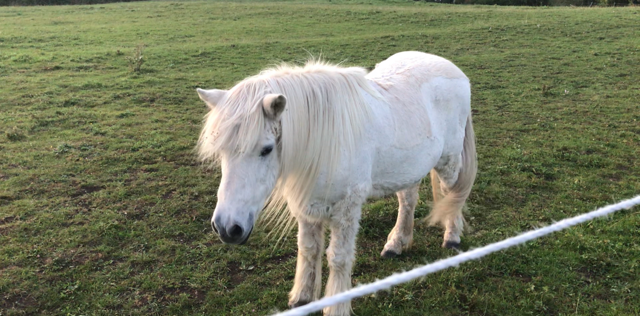
The old pony is always right

A short chat message exchange with an acquaintance leads me to the conclusion: The old pony is always right.

We had briefly talked about a work appointment that had to be postponed due to illness, and somehow ended up discussing where on earth one is supposed to find the time for all the things we have to fit in — or want to fit in — at work and in our private lives. We quickly agreed that time with the pony, already 31 years old, should definitely take priority (in human years, that’s about 95!). And we agreed that overtime at work (or simply “working more”) is usually not the solution to problems at work.

I thought: the pony is already old — who knows when it will die — so you’d better spend time with it while you still can.

But I also thought — and I told her this — the pony is a “giver of good time.” And that is precisely why the pony deserves priority even more. I would even claim: The pony makes us happy in our free time, but also more productive at work. Because only brains and people and souls that are truly relaxed for once, that can breathe deeply and let everything go, can see the forest behind all the trees again and approach things with a clear view, free thoughts, good faith and good patience.

A few weeks earlier, my acquaintance had told me that thanks to a few sick days at home, she had gained a clearer view of a situation at work. That was when she realised there was a problem — or at least a serious risk — connected to a change that had just been implemented in her company.

So I say: Old ponies are always right. Because these beautiful hobbies we immerse ourselves in, where we forget everything for two or three hours, ensure that our mind becomes completely free. During that time, all the noise disappears, all the smoke above the actual fire. And this is not to be understood as me suggesting that one should start thinking about work problems while riding a pony in green nature. I would strongly advise against that — the pony probably wouldn’t like it very much either (I assume ponies can sense quite well how present and attentive you are while riding). It might even lead to riding accidents in the end, and we certainly don’t want that.

Above all, we don’t want the brain to be harnessed to the cart again, burdened and occupied with annoying work thoughts that it would do better to let go and allow to fly away — precisely to separate what is essential from what is not. I’m not worried: The insights will return by themselves the next day at work or the following week — but freely, with new perspectives.

And that is exactly what helps in solving problems: First of all, getting a view of what the problem actually is, where it is, what it consists of, and why it should matter at all. And even there — with this immensely important question of what it is ultimately about, and what is meant to be achieved — the old pony helps us along beautifully. Because such an old pony reminds us wonderfully of what life is really about.

And no, this is not where the answer to all philosophical questions appears — the famous 42. And no, of course, an old pony is not the right hobby for everyone. No — the pony (and other beautiful hobbies) helps us, as individuals and as human beings, to feel what truly matters to us in life. And that also includes: why we like this job (or don’t), and why it matters to us that it runs well, that it feels right, that we can use our abilities well, and that it gives our clients what they, in turn, need.

The pony is therefore also an important piece of argumentation in a discussion I occasionally have with another friend: Do we work only for the money? And if we see it that way, can we really do very good work? In other words: Can we solve problems in such a way that we are not merely serving the purpose of “making money,” but can actually be effective for something people out there need for a good life — and for which they, as customers, are willing to spend money and time?

Whether that matters or not in an employment relationship may be a matter of opinion. I think that wherever people want to live their lives well, it certainly takes more than money. For example, the incredibly good, richly fulfilling time one can experience with a pony. Despite (and perhaps even because of?) the work it requires and despite the “wasted” money for feed, stable and equipment.

And I also think — and have experienced it so often in my career — that this makes an essential difference at work as well: Why, for what, and for whom we do this work, and how it contributes to a good life. It makes a difference to how we look at problems and which goals we pursue: in the experience of the work itself and in the results one can make possible — for clients and for one’s own company.

What would the pony say about all this? Certainly not: „Life isn’t a walk in the park“ (or, as we would say in German, literally: „Life is no pony farm.”)

And I know from my own experience at work: Whoever has lost this connection to their inner pony — that is, to what they are actually doing this work for — easily loses their way in the wrong problems and looks for the wrong results in “solutions” that in the end, for example, don’t interest customers at all and certainly don’t bring more good pony-time into the world — for anyone.

Who has stolen all that time again?

Are we ‘human doings’, working in the system – or human beings, working on the system?

In your busy work-weeks, when Friday comes, do you frequently have that feeling: “I should have done this and that, but hey, the time is gone again!” And you wonder: “Who has stolen the time again, this week?”

Some readers in Germany might have come across a book called ‘Momo’. It was a great success in the 90ties, telling the story of mysterious men in black suits who steal time from people. A little girl – Momo – gets into the adventure by trying to find out what these men do and how they steal time.

In the story, I remember, she reveals they don’t do it by influencing ‘the time’ itself, but by driving people to do more activities throughout their day. These men are the cause of additional activities that finally leave people with the impression that their time has been stolen.

I am reminded of that story when I hear time and time again statements from various actors in companies: “We don’t have time to work on change”. Or: “Yes, that should be tackled to be more proactive and stop some of the firefighting in future, but again, there were too many urgent issues this week.” This is often the answers that we hear from others. And very often we say the same thing, particularly when we are asked about the progress of our own plans.

If we are honest, the statement does not only apply to the workplace but also to our private lives. “I don’t have time”  is a welcome and easy label, putting a dense fog in front of our real problems and saving us from serious reflection or revelations about our personal priorities or weaknesses.  Maybe, a better way to express this ‘time-problem’, while avoiding the dark depths of those personal weaknesses, is this:  “I don’t spend my time on this, but on other things.”

Clearly – very clearly – we all have too many things to do within any busy job, but we all have the same amount of time, that’s the law of ‘physics’. However, how about changing our use of language again by saying: “I don’t spend my time on this, but on other things.” And: “I have more tasks to do than I can do”. This changes the focus of our attention.

Simply saying “I have no time” distracts us towards an imagined scarcity of time – as if somebody had stolen the time like the men in black from the ‘Momo’ novel. It does not have to be like that.

In contrast, saying “I spend my time on other things” leaves us at the end of the sentence with “other things”. Which is a perfect starting place to think about what these other things are and where these other things are coming from. Questions can then be asked, such as: “What causes these activities? What is the real need for it? What is their purpose? Finally, we might ask: How can I reduce the number of these things that hinder me from doing those other things, where purpose, need and value are clear to me?

In a situation of  ‘too much to do’ we are the ones, who are making the choice of which activities we do and don’t do. Nobody,  in normal organisations, puts us in chains or gives us drugs or stands with a loaded revolver behind us to force us to do certain activities. If there is a list of more things to do than we can do, we are obviously making a choice. But what is informing that choice?  How do you choose what to do or not to do?

Our time is not stolen. We give it away without realising because we let others choose for us, we blame others, not ourselves for being overburdened. We choose to say, it’s not us, but our managers or our customers that are removing choice: We should keep in mind that as long as they ask from us more than we can do, it is not their choice, but ours in the end. Simply because, again, it is impossible to do all within the time we have.  So, from that angle, it looks like if we have some freedom of what we do as human beings in a normal office environment. We are not slaves or robots, and we are not human doings but human beings.

However, I realise it does not feel like that. Yes, it is hard to deal with pressure and to keep control, feeling you have no chance to become proactive and sometimes no chance to even be reactive. Because something is working on us from outside. Something, and not someone, is stealing your time. You could call this stealthy time stealer ‘the system’.

The ‘business and working system’ pushes and pulls us towards so many directions that at the end of the day, we say ‘I had no choice’. And indeed, as long as we only think and react within the logic of that system, we feel as if we do not make choices. However, thinking and staying in that system is a choice we make. We could also choose to think and act and work on the system, instead of thinking and working in the system.

So, how to get out of this trap? A very simple start is to delete “I don’t have time” from our vocabulary and to replace it with: “I don’t spend my time on this, but I spend my time on other things.” Then, ask: “What are these things?” – “Where do these things come from?” That is already thinking about the system, instead of just reacting in the system. When you ask: “What activities on my list are those that have potential to remove causes of other activities on the list?” Then you start thinking about where you can start to influence the system. You start thinking about where you can choose those activities on your list, where you can work on the system, and where you can start to change the system.

Do we ask what is creating value for our customers? What is value for our management? Can we change the system to produce less waste?  Can we create a space for new possibilities and different ways of working that give back time instead of stealing time?

I still wonder why many times we still choose to do the important things last or not at all: Things that can secure our future by changing the system. Things that can open a way out of the waste that fills our task lists. Wouldn’t it make sense to choose those activities first that can help to remove the need for other waste activities on our list?

So, give it a try. Stop saying “I don’t have time.”  And go with “I don’t spend my time on this, I spend my time on other things.” And listen to the echo to follow and track down from which corner in the system they come from, those ‘…other things…other things …other things…’